USDA Loans in Wilson County, Tennessee: The Zero-Down Option Most Lebanon Buyers Never Check
 Tyler McCain, Sr. Mortgage Loan Advisor
NMLS #173261 · ·
Updated
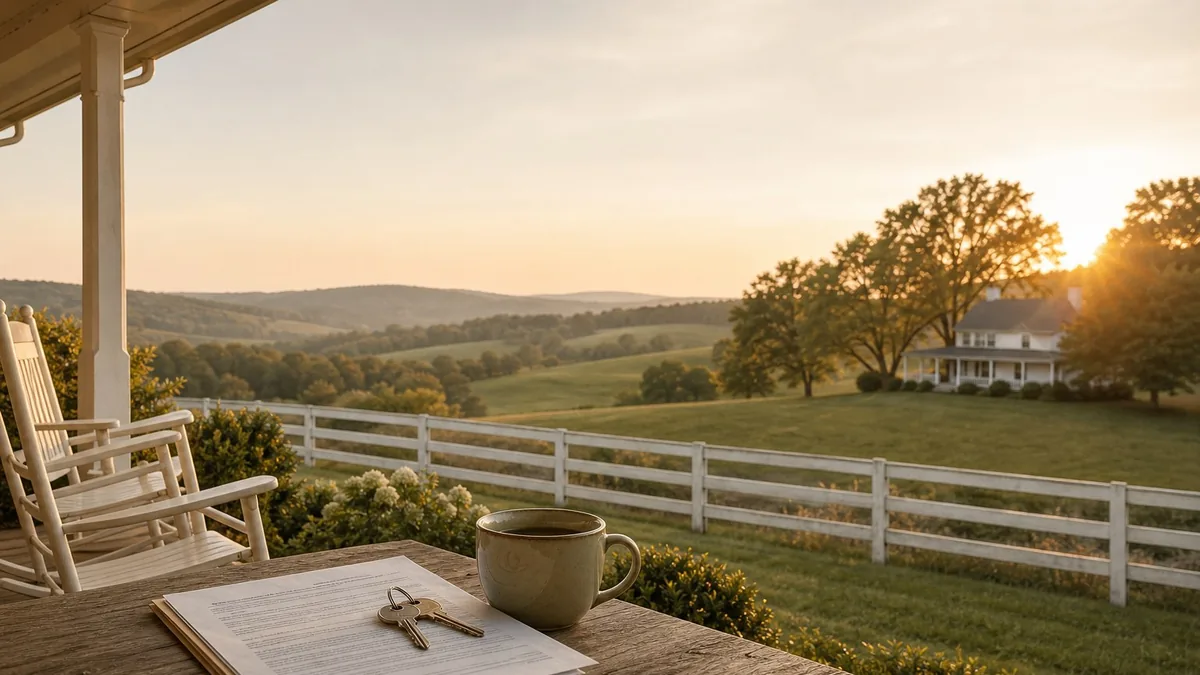
Almost every week someone tells me they are two years away from buying because they are still saving a down payment. Often they are not two years away. They are looking at houses that qualify for a loan requiring no down payment at all, and nobody has told them.
That loan is USDA, and Wilson County has a lot of it.
The short answer: A USDA loan finances 100% of the purchase price on an ordinary thirty-year fixed mortgage, so the minimum down payment is $0. Two tests decide it. The house has to sit in an area USDA has designated rural, which covers much of Wilson County outside the Lebanon and Mt. Juliet city limits. And your household’s adjusted income cannot exceed the county’s moderate-income limit, which the federal rule defines as the greater of three measures, starting with 115% of the U.S. median family income. It is for a primary residence only.
The two things everyone believes about USDA are both wrong
“It’s for farms.” It is not. The program is named after the department that administers it, not the kind of property it buys. There is no acreage requirement, no livestock, no agricultural use test. It buys ordinary houses in ordinary subdivisions. If anything the rule runs the other way: under the federal regulation the site must not include income-producing land. What matters is where the house sits on a map.
“That ended years ago.” Also no. The program is active, it is funded, and it is used constantly across Middle Tennessee. It is simply not advertised, because it is a government guarantee rather than a product a bank makes money promoting.
USDA vs. FHA, conventional and VA at a glance
Here is how USDA sits next to the other low-down-payment loans we place for Wilson County buyers:
| USDA | FHA | Conventional | VA | |
|---|---|---|---|---|
| Minimum down payment | 0% | 3.5% | As little as 3% | 0% |
| Down payment on a $350,000 house | $0 | $12,250 | $10,500 | $0 |
| Limited to certain areas? | Yes, designated rural areas | No | No | No |
| Household income ceiling? | Yes, the moderate-income limit | No | No, on a standard loan | No |
| Who can use it | Any household that fits the two tests | Most buyers | Most buyers | Veterans and service members with entitlement |
| Monthly insurance-type cost | Annual fee, collected monthly | Monthly mortgage insurance | Mortgage insurance that comes off later | None |
The first two rows are why this loan is worth a phone call. On a $350,000 house, the difference between USDA and FHA is $12,250 you do not have to save first.
Eligibility is a map, not a feeling
USDA publishes a property eligibility map, and it is drawn by census-defined population, not by how rural a place looks when you drive through it.
Here is the part that surprises Lebanon buyers: eligibility does not stop at the edge of town. Drive out past the Lebanon city limits in most directions and you are into eligible territory quickly. The same is true across much of the county between Lebanon and Watertown, and out toward the Smith County line. Some of these are established neighborhoods with sidewalks and a school bus route, not farmland.
Mt. Juliet is largely excluded now. It grew its way out of eligibility, which is exactly what happens to successful suburbs. That boundary has moved before and it will move again. If a house is eligible today, that is a today fact, not a permanent one.
There is a protection built into the rule for buyers caught mid-purchase. If an area’s designation changes to nonrural, USDA honors the commitments it has already issued, and a loan request can still be approved when the application and the purchase contract were complete before the change. The lesson is not to panic. It is not to sit on an eligible address for a year either.
You do not have to guess at any of this. Send me an address and I will check it against the map in about a minute. It costs nothing and it is not an application.
What “zero down” actually means here
One hundred percent financing on a normal thirty-year fixed-rate mortgage. Not an adjustable rate, not a balloon, not a teaser. The same loan structure as everyone else’s, without the down payment.
Zero down does not mean zero cash. There are still closing costs and prepaid items such as insurance and taxes, and how those get covered is part of how we write the offer. But the single biggest number most buyers are saving toward, the down payment, is not required.
What the USDA guarantee costs
USDA does not charge mortgage insurance by that name. It charges two fees for the guarantee:
- An upfront guarantee fee, charged once at closing and usually rolled into the loan. The regulation says it will not exceed 3.5% of the loan amount.
- An annual fee, collected monthly as part of your payment. The regulation caps it at 0.5% of the average scheduled unpaid principal balance for the year.
Those are the legal ceilings, not the price. USDA sets the fees it actually charges by notice and can change them, so I quote the current figures on your Loan Estimate rather than from memory.
The annual fee is meaningfully lower than FHA’s monthly mortgage insurance. That is why, for buyers who qualify for both, USDA often wins on total monthly cost even before you account for keeping your savings in your pocket. The fuller comparison is on our page about USDA loans in Tennessee.
The income limit is higher than you think
This is where people disqualify themselves incorrectly.
The rule is that the household’s adjusted income must not exceed the moderate-income limit for the area. Two words in that sentence do a lot of work.
Household. The limit counts the whole household, not just the people on the loan. That part catches some families out.
Moderate. It is not a low-income program. The regulation defines moderate income as the greater of three measures: 115% of the U.S. median family income, the average of the statewide and state non-metro median family incomes, or 115/80ths of the area’s low-income limit adjusted for household size. Whichever is highest wins. In practice the limit is considerably more generous than the phrase “rural development loan” suggests. Plenty of two-income households in Wilson County are under it.
Adjusted matters too. There are deductions, for dependents, for childcare, and for certain medical expenses, that can bring a household back under the line when the gross figure looks too high. I have had files qualify that the borrower was certain would not.
If you are anywhere near the number, get it calculated properly rather than assuming.
The honest part: USDA is slower
I would rather tell you this now than at closing.
A USDA file goes through an extra step. After the lender approves it, it goes to USDA for the guarantee commitment. That step adds time, and when funding cycles lapse it can add more. If you are competing for a house against a cash offer with a two-week close, USDA is a hard sell to a listing agent.
There are two other limits worth knowing. USDA is strictly for a home you will live in. The regulation is blunt about it: Rural Development will not guarantee loans for investment properties or temporary, short-term housing. That means no second homes, no rentals, no house-hacking. And the income limit is a ceiling, not a guideline; a dollar over is a decline.
How to find out in a day
- Send me the address, or the part of the county you are shopping in. I check it against the eligibility map.
- Tell me who lives in the household and roughly what everyone earns. I run the adjusted income against the Wilson County limit for your household size.
- Let me price it against the alternatives. If you also qualify for FHA or a conventional loan, you should see all of them side by side, which is the whole reason to use a broker. I explain that in mortgage broker vs. bank in Middle Tennessee.
You can rough out the payment yourself first with the Tennessee mortgage calculators.
When it is the right answer
If you are buying outside the metro core, plan to live in the house, and are under the income limit, USDA is frequently the cheapest way to own a home in this county. The down payment you were saving for two more years is not required, and the monthly cost often beats the alternatives. And if the house you want is one you have not built yet, USDA has a zero-down, one-close version for that too. I walked through how it works in construction-to-permanent loans in Middle Tennessee.
If any of those three do not fit, one of the other low-down-payment routes probably does: FHA loans in Tennessee at 3.5% down, conventional loans in Tennessee from 3%, or VA loans in Tennessee at zero down if you have entitlement. There is more on all of them on our page for first-time home buyer loans in Tennessee, and the full list is under mortgage loan programs in Tennessee.
USDA loans in Wilson County, Tennessee FAQ
Is Lebanon, TN eligible for a USDA loan?
Eligibility is decided address by address on USDA’s property eligibility map, not by city name. Much of Wilson County outside the Lebanon and Mt. Juliet city limits is eligible, including established neighborhoods, while addresses inside those city limits often are not. Send us the address and we will check it.
What is the USDA income limit in Wilson County?
Your household’s adjusted income cannot exceed the moderate-income limit for the county, and the limit rises with household size. Federal rules define moderate income as the greater of three measures, one of which is 115% of the U.S. median family income. The limit counts everyone in the household, not only the borrowers, so we calculate it for your household before you rule yourself out.
Do I really need no down payment for a USDA loan?
Yes. A USDA loan finances 100% of the purchase price on a standard thirty-year fixed-rate mortgage. You will still have closing costs and prepaid items such as insurance and taxes, and how those are covered is part of how the offer is written.
Does a USDA loan have mortgage insurance?
Not by that name. USDA charges an upfront guarantee fee and an annual fee that is collected monthly. The federal regulation caps the upfront fee at 3.5% of the loan amount and the annual fee at 0.5% of the average scheduled unpaid principal balance. The fees USDA actually charges are set by notice and can change, so the current figures appear on your Loan Estimate.
Can I use a USDA loan for a farm, a rental or a second home?
No. The home must be your primary residence. The regulation states that Rural Development will not guarantee loans for investment properties or temporary, short-term housing, and the site must not include income-producing land. An ordinary house on a rural lot is exactly what the program is for.
What if the area loses USDA eligibility while I am buying?
The rule protects buyers who are already in process. If an area’s designation changes to nonrural, USDA honors the commitments it has already issued, and a loan request can still be approved when the application and purchase contract were complete before the change.
The bottom line
The mistake is not choosing the wrong loan. The mistake is spending another two years saving for a down payment you may not need.
I am the local mortgage broker in Lebanon, TN, and checking an address is the fastest thing I do all day. Send me the address and I will check the map, or start here and we will look at the whole picture.
Want this run against your actual numbers?
Your information is reviewed by our lending team — not an automated system.
Let's Start The Conversation